AI photoshoots for jewelry brands: from a phone photo to a model anywhere
How an AI photoshoot works for jewelry and accessories brands — what to send, what you get, where it beats a studio shoot and where it doesn't.
A jewelry brand needs a lot of pictures: listing photos for every product and colour, lifestyle shots for the website, fresh images for Instagram every week, and new creative for ads every time the old ones get tired. A traditional photoshoot covers one day, one location and one model. An AI photoshoot turns the product photos you already have into model photos in any location, and you can order a new set whenever you need one.
This is how we do it for jewelry and accessories brands, and what we've learned shooting a whole Etsy shop this way.
What an AI photoshoot actually is
You send clear photos of your product, and we place it on an AI-generated model in the setting you want: a blue wall in the city, a festival at sunset, a candlelit dinner, a staircase in a sequin dress. The product stays yours. The model, the light and the location are made with AI image and video tools, then checked and retouched by hand.
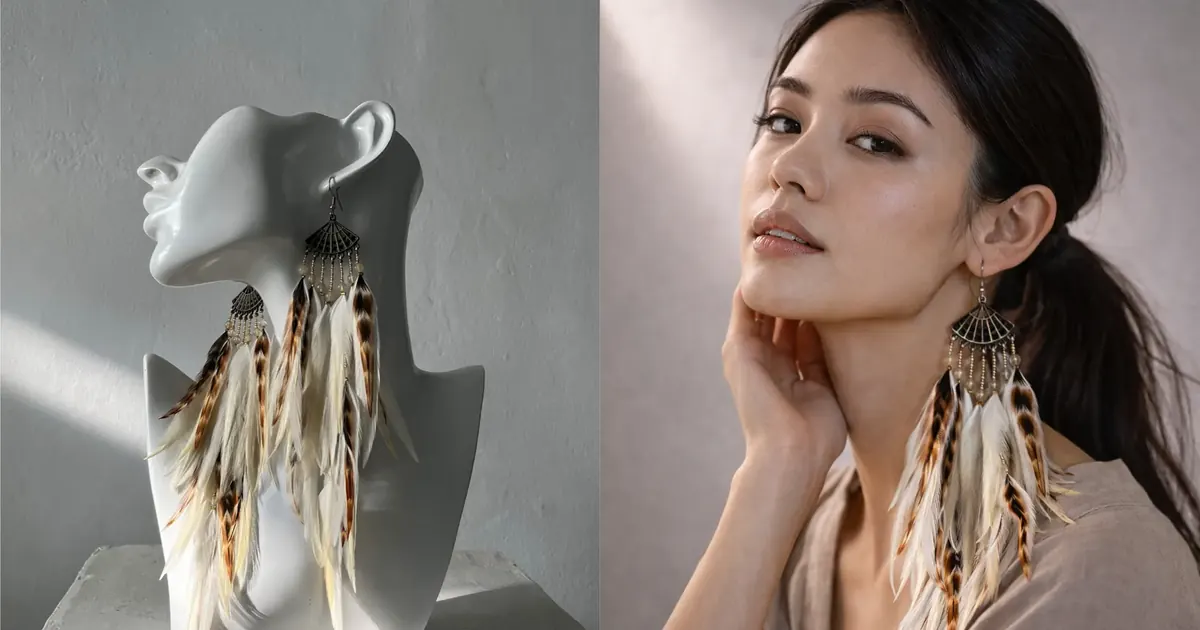
The image at the top of this post is a real example. On the left is the brief, a product photo of feather earrings on a mannequin bust. On the right is the finished shot with an AI model.
What you need to send
- Phone photos are enough. Shoot in daylight, against a plain background, without filters.
- Every angle that matters: front, side, back, and a close-up of the details such as the clasp, the stones, the texture or the engraving.
- True colour. If the metal is rose gold or the feathers are dyed a particular turquoise, tell us. Colour is what customers complain about first.
- Scale. The length of an earring or the size of a pendant, so it looks the right size on the model.
- A mood board (optional): two or three images of the look you like, or links to brands you admire.
How a shoot runs
- Brief. Agree on the products, the number of images, where they will be used (Etsy, website, Instagram, ads) and the formats you need: square, 4:5, 9:16 or wide banners.
- Model and location concept. Choose the model's look, the styling and the settings. One product can appear in five different worlds in the same set.
- Generation and retouching. We make the images, select the best ones and retouch the product so it matches the real piece.
- Accuracy check. We compare every image against your product photos for shape, colour, size and the number of elements. Anything that doesn't match gets redone.
- Delivery. You get web-ready files in your formats, and short AI video clips if you ordered them, ready for Reels, TikTok and ads.
The proof: a whole Etsy shop shot with AI
Every model photo in the Sage or Savage Etsy shop is AI-made. The brand sells feather earrings and hair clips. Instead of booking a studio, we created a cast of models and put the same products in many different scenes. You can see the latest set in the gallery on our AI photoshoot page.
Where AI photoshoots work best
- Jewelry and accessories: earrings, hair clips, necklaces, rings, bags and hats. The product is small and well defined, so it's easy to keep accurate.
- Listing photos at scale: a consistent look across dozens of products and colours.
- Fresh social content: new scenes every week without a new shoot.
- Ad testing: the same product in different settings, so you can see which one sells.
- Brands outside Bali: you never ship samples or fly a crew. Send photos from New York, Paris, Milan, Sydney or Singapore and we do the rest remotely.
When a real photoshoot is the better choice
AI is not the answer to everything. If fit and drape are what you're selling, as with flowing dresses and tailoring, or if you want behind-the-scenes content with real people, a real camera is still better. That's why we offer both: an AI photoshoot anywhere in the world, or a real on-location shoot in Bali with our own photographer and videographer, which we quote separately.
A note on honesty
Customers should get exactly what they see. We keep the product itself true to life, and we recommend checking each marketplace's current rules on AI imagery before you publish. An accurate AI photo builds trust; one that flatters the product too much ends in returns.
Want to try it?
Send us three to five photos of one product on WhatsApp and tell us where you'll use the images. We'll suggest a concept and a quote. More examples and the FAQ are on the AI photoshoots page.